

We have and 5 Scanning Electron Microscope (SEM) calibration blocks and one for a Backscattered Electron Detector
(BSED).
SEM Calibration Blocks.
Resolution Standard. These standards are supplied as Gold particles on Carbon in the following sizes
There is a choice of three different Resolution standards used for testing the
resolution of the SEM. Both large and small gaps are resolvable from the gold crystals grown on a graphite substrate. A certificate of calibration is included in the price for each one..These standards are supplied
mounted on a 6mm dia. removable mount.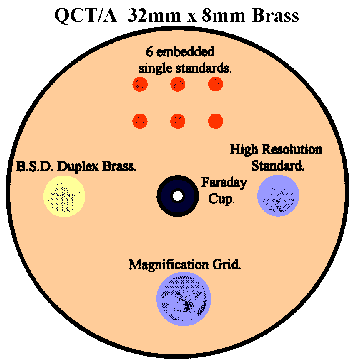
Medium Resolution This is an
option for a single standard block, (QCT/A & QCT/AA), 5nm-15nm or the second standard in a two standard block (QCT/B & QCT/BB & QCT/C). Approximate magnification required 50,000 to
200,000 times.
High Resolution This is the resolution standard contained in the price quotation 2nm-30nm for a block with one standard. (QCT/A & QCT/AA) Approximate magnification required 50,000 to 250,000 times.
Magnification Grid. The magnification grid is mounted
on an 8mm dia. removable mount, ensuring that if in future there is a need to replace this standard with a different one, it can be done easily and with minimum cost.
There is one Magnification Calibration Grid. This is used for the Calibration of the Magnification of the SEM. It's construction
is a 5mm x 5mm Single Crystal Silicon square of material. On the silicon is produced lines with Electron Beam Lithography, in a square grid pattern. The Border grid squares are 500 by 500
microns. Inside these are 10 x 10 micron pitch grid squares of approximately 1.9 micron line width.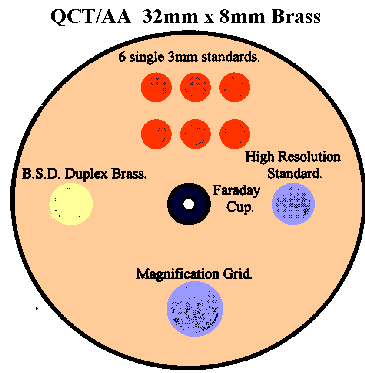 A Certificate of calibration is included in the price.
6 Single Standards.
Six standards can be supplied as
specified by the customer from our extensive range of over 250 different standards in either embedded or as 3mm single standards. Certificates of analysis are included in the price of the block for each standard. If the
system has an Energy Dispersive X-Rayanalysis system attached, then one of these standards could be Cobalt, which is a common standard for calibration.
BSD Duplex Brass.
One 5mm dia. removable standard of Duplex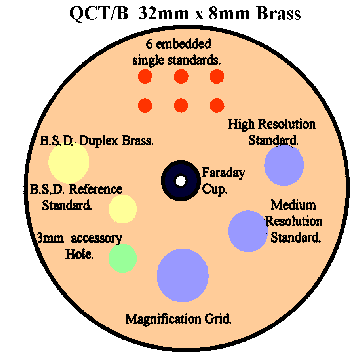 Brass is included. This is used for checking the resolution and performance of the Backscattered Electron Detector. The resolution of a detector is
usually quoted as 0.1 (Z) where the atomic number (Z) = 30. This is obtained in our Standard by the mean atomic number between the phases of a/b
Brass, being 0.1 Z.
Brass is included. This is used for checking the resolution and performance of the Backscattered Electron Detector. The resolution of a detector is
usually quoted as 0.1 (Z) where the atomic number (Z) = 30. This is obtained in our Standard by the mean atomic number between the phases of a/b
Brass, being 0.1 Z.
Faraday Cup.
The Faraday Cup is included and is use to measure the probe current. This is a parameter of vital importance in micro-analysis for fully quantitative analysis.
BSD Reference Standard.
This is one of our dual standards used to calibrate and check the Backscattered Electron Detector with a resolution of one atomic number (1Z). There is a choice of 4 standards to choose from. AlSi
(Z=13/14); Ni/Cu (Z=28/29); Pd/Ag (Z=46/47); Pl/Au (Z=78/79). 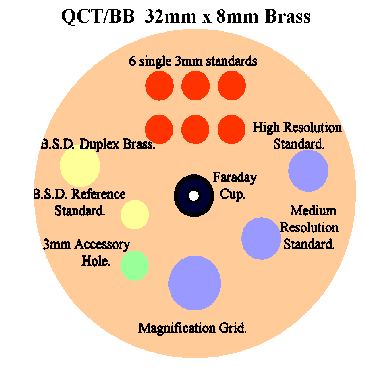 Certificates of analysis are included in the price of the block. It is mounted in a 3mm dia. removable block.
3mm Accessory Hole.
Three of the Blocks have a 3mm
accessory hole which can be used for any standard the customer would like or left empty. If the system has an Energy Dispersive X-Ray analysis system attached, then this standard could be Cobalt, which is a common
standard for calibration.
Standard Block.
One of the blocks (QCT/C 5Omm dia.) has a hole of either 25mm or 32mm in which the customer can insert his own block of standards. Alternatively we can
supply custom blocks of standards in either 25 or 32 mm dia. With over 250 different standards to choose, from our extensive range, we can mount up to 52 standards in a 25 mm dia block.
General. It is recommended that Blocks of standards are returned to us for Re-polishing and Re-coating every
two years. This service is performed at a nominal fee for our customers and will reduce contamination to the standard surface which will adversely affect the performance of the standard
Our standards are diamond polished to a 0.25 mm 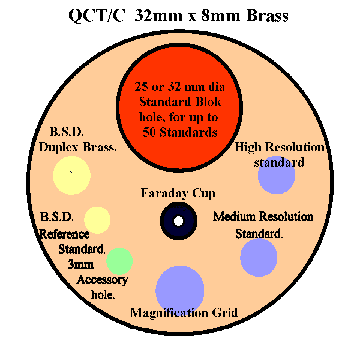 finish and coated with approximately 250Å (can
be customer specified) of carbon to reduce charging produced by the electron beam.
finish and coated with approximately 250Å (can
be customer specified) of carbon to reduce charging produced by the electron beam.
Backscattered Electron Detector Calibration Standard.
Ø30mm x 5mm Carbon Block.
Certified Standards For System Calibration.
Coated with approximately 250Å of Carbon.
Diamond polished to 0.25mm surface finish.
Checks Detector and SEM Performance.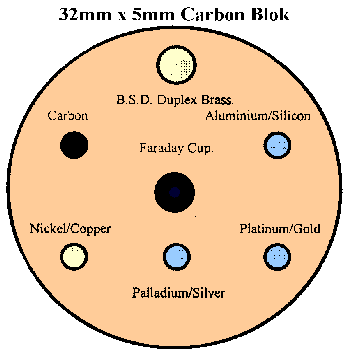
Contains:
Duplex a/b Brass to cheek atomic number Z = 0.1 resolution.
4 Standards to check atomic number Z = 1 resolution.
Vitreous Carbon atomic number Z = 6.
Faraday Cup to set probe current.
Also available:
5mm x 5mm Single standards containing two elements:
Aluminium / Silicon (Atomic numbers 13/14)
Nickel / Copper (Atomic numbers 28/29)
Palladium / Silver (Atomic numbers 46/47)
Platinum / Gold (Atomic numbers 78/79)
5mm x 5mm Single standard containing:
Duplex Brass (0.1 Z Mean atomic number between phases)
